Salt shaped the landscape.
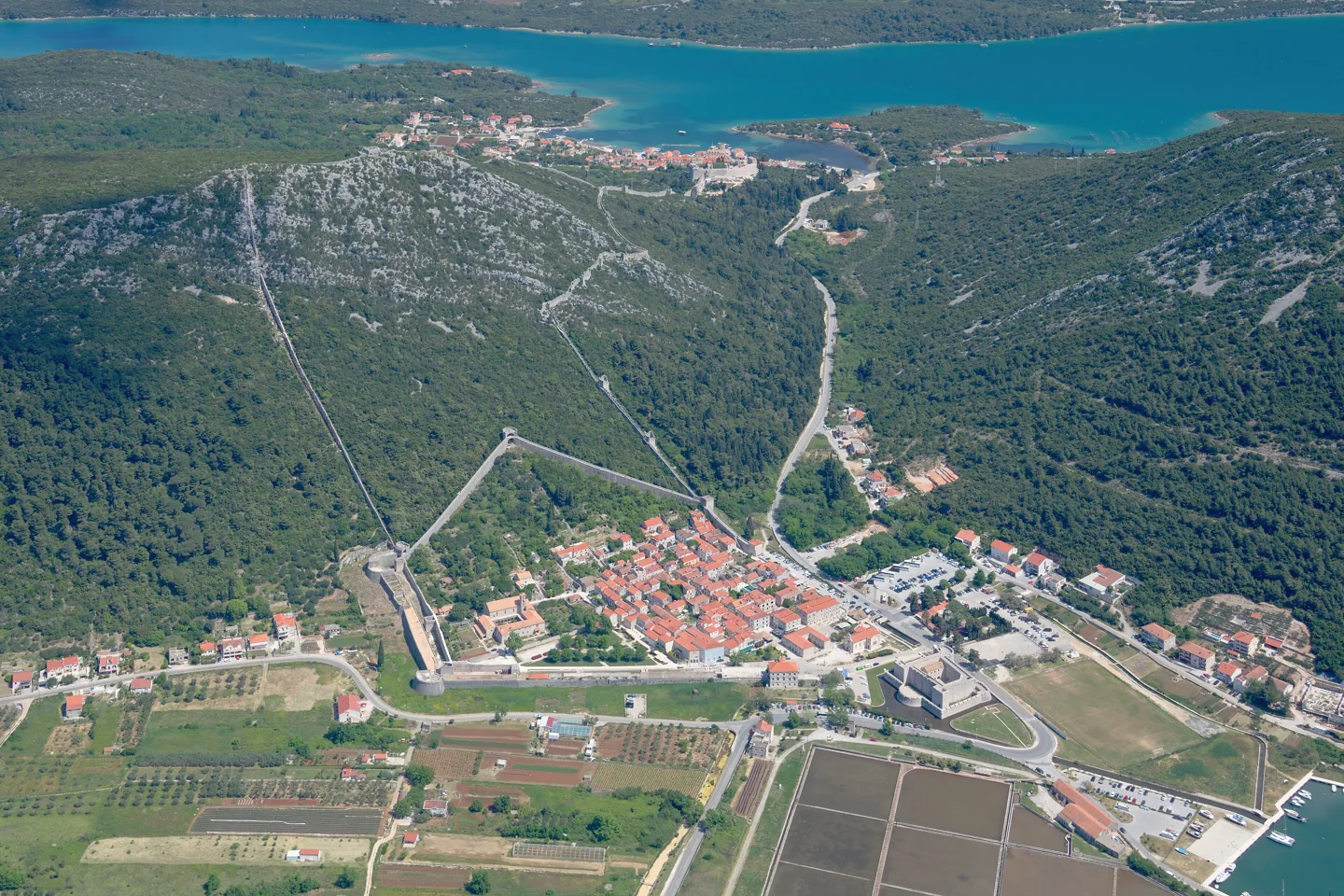
The salt pans are the key to Ston. Sea water, sun and wind turn shallow pools into a productive landscape. Salt was a strategically important commodity for the Dubrovnik Republic; protecting its production helped shape the extraordinary defences around the town.
Visit the walls and saltworks together to read both sides of this history. The heights reveal the pattern of the pools. At ground level, the scale becomes human: channels, embankments and the patient work of evaporation.
History of the saltworks · Solana Ston1333: a new chapter.
Ston and Pelješac came under the Dubrovnik Republic in 1333. Fortification and planned urban development followed, creating the connected centres of Ston and Mali Ston. The walls secured the narrow landward approach to the peninsula.
This was not a monument built in a single moment. Defences were strengthened and adapted over centuries as needs, building methods and military technology changed.
Two towns. One system.
Look at the regular streets of Ston, then at the wall rising towards the ridge. Together, town planning and fortification tell a coherent story. Veliki Kaštio in Ston, Koruna in Mali Ston and Podzvizd on the hill form key points of the historical system.
The operator describes the original defensive complex as roughly seven kilometres long. That historical figure includes different stretches and fortifications; it is not a promise of seven kilometres of continuous public walking route.
A living inheritance.
Earthquakes, changing uses and the removal of parts of the defences altered the walls over time. Conservation by the Society of Friends of Dubrovnik Antiquities has helped bring this heritage back into view.
Walk with the understanding that this is a cared-for historic place. Keep to the marked route, respect temporary closures and leave the stone as you found it. The most rewarding detail may be the one you notice when you stop.
History of the walls · DPDS